
Exiting The Stream: Spotify
Even if unwholesome action fills worlds upon worlds, and swallows up all things, opting-out is emancipation
One night a few weeks ago, after finding out that a good friend who I hadn’t heard from in awhile was in the hospital for some major medical problems, I stayed up listening to “the spiritual sound of ecstatic black metal by the band Agriculture” and cried my guts out.
Fresh Inter-Dimensional Music down below, or click here and listen to a “live-to-FLAC from the yoga mat” mix of Primitive Man, Dub Syndicate, and Joko Beck as you read.
I did not want to share my grief with Spotify, Apple Music, Tidal, YouTube, Bandcamp, nor any other lurking facilitator. I did not want my listening experience to be interrupted by information about new flavors of Starbuck treats or details of the lucrative signing bonuses on offer to American Gestapo recruits. I did not want Spotify to flag this emotionally wrenching night on an annual user surveillance report. I did not want the temptation to start scrolling BlooSkeets on the device that was playing the music, looking for something funny or disturbing to distract me from my uncomfortably raw feelings. I just wanted to sit and feel sad about a friend who is nearing the end of their days while a group of fellow Zen practitioners scream over a hypnotic frenzy of guitars and polyrhythmic drumming about how “mountains are mountains / just as they are / not as I want them to be.”
The price of grieving without advertisements, of grieving privately to queer Zen black metal unperturbed by alarms or phone calls or credit card notifications, the price of fading into silence when the album finishes rather than auto-play hustling me on to the next thing is $10.50.
If you use Spotify1 to stream music, that’s fine. And who cares what I have to say about it anyway? Why pretend that denying a massive multinational corporation your $10 monthly subscription fee will have a substantial impact on their defense industry investment portfolios?

That being said, when there is an organized effort toward change, sometimes it has an effect. As a result of many people saying mean things about Spotify online and IRL for years, there actually appears to be a small but not insignificant organized effort by musicians and fans to leave the platforms that are actively undermining their ability to make a living. I don’t know if it’s working, but the Bandcamp bestselling albums feed has looked more like a King Gizzard and The Lizard Wizard2 fan page since the confusingly popular Australian prog-jam-band-collective pulled their tunes from the streaming service.
I also think it’s fine—good, actually!—for people to have easy access to an incredible amount of music. In the spirit of public libraries, I think it would be wonderful if our society decided to subsidize cultural production so that creation of—and access to—art doesn’t depend on advertising revenue or the patronage of generational wealth hoarders. That system isn’t working out very well for most of us! The privilege of experiencing a broad range of writing, visual art, film, and music should not be denied to people based on their income. As anthropologist and activist David Graeber wrote in the beloved and oft-cited (by me) manifesto “To save the world, we’re going to have to stop working”:
It’s not our pleasures that are destroying the world. It’s our puritanism, our feeling that we have to suffer in order to deserve those pleasures.
So this is not intended as a guilt trip for anyone who continues to make their daily grind a smidge more tolerable by spending $10/month for immediate access to one of the largest collections of music in the history of civilization. But for a naive idealist such as myself, there are reasons to avoid Spotify that have more to do with how I want to exist in the world, than with forcing the world to conform to my wishes. Listening to music without relying on the rent extraction-schemes of authoritarian broligarchs restores some of the sacred intimacy of connecting to other humans through shared aesthetic experience. Paraphrasing words of the 13th Century Zen Master Dōgen, “Even if unwholesome action fills worlds upon worlds, and swallows up all things, opting-out is emancipation.”
With all of that said, I am tired of having the same conversation with people who 1) feel bad about using Spotify, 2) have enough walking around money to spend on media in addition to their Spotify subscription, but 3) say that they do not know how to stop using Spotify. It’s another instance of people avoiding a difficult decision because they “don’t know what to do.” Often the reality is that we do know what to do, but we don’t want to do it. Instead of crowing about switching from Spotify to a streaming service that’s less open about its support of ICE, or one that pays artists one penny per stream rather than one quarter of one ha’penny, maybe post some Bandcamp receipts?
365 Days of Inter-Dimensional Music

In 2024 I purchased or somehow otherwise acquired almost 400 new albums, EPs, and singles. 370 of those pieces of music came from Bandcamp, a music retailer that pretends to be a music magazine, but is really an online store that used to be cool and nice except corporations are never actually cool and nice: They’re amoral corporations and even if you like what they’re doing today all of them will eventually sell out to larger corporations and
In the interest of full disclosure, we have a Spotify account, though I rarely use it. One exception was a night this last May when I drank too much tequila and stayed up too late getting too sentimental by listening to too much Terry Allen. It’s weird and creepy and genuinely unnerving that one of Spotify’s lurking facilitator droids flagged this as a night of unusual listening, notifying my partner—the account owner—seven months later on the just-released Spotify year-end surveillance report.
“The day you circled Lubbock in endless company,” it begins, somewhat ominously, especially if you’ve visited Lubbock. “Your late evening was a revolving door of Terry Allen’s ‘Lubbock (on everything),’ looping ‘Amarillo Highway (for Dave Hickey,’ ‘High Plains Jamboree,’ and ‘The Great Joe Bob (a Regional Tragedy)’ for extra mileage. 51 minutes, 14 plays, 1 artist—your most repeat-heavy day, with outlaw country on endless loop.” Which is annoying to begin with because listening to a couple songs for less than an hour is hardly “an endless loop,” but mostly because I did not realize that a corporation run by AI drone warfare enthusiasts that recruits its users for Republican kidnapping squads was taking detailed notes on a lonely Saturday night and my indulgence in 15-year-old memories of “slow dancing through the neons / like sorrow through a song.”
Is it a poor excuse that this Spotify membership is part a very old but somehow still valid bundle with a streaming TV channel subscription? Probably! But I’m not making excuses, nor am I asking for yours. For what it’s worth, even though I’ve scaled back my media budget out of necessity, I’ve purchased almost 150 albums, EPs, and singles on Bandcamp over the last 12 months, thanks in part to the support of the 34 literal angels with paid subscriptions3 to Vøid Contemplation Tactics. Thank you! Next time I’ll spend $12 so I can listen to sad dirtbag Texas ballads without logging my listening data with ICE recruiters.
“We must negate the machines-that-think,” proclaims the minister companion of the Butlerian Jihad. “Humans must set their own guidelines. This is not something machines can do. Reasoning depends upon programming, not on hardware, and we are the ultimate program! Our Jihad is a ‘dump program.’ We dump the things which destroy us as humans!”
This “Exiting the Stream” series of Luddite virtue signals is a peculiar contribution to the Butlerian Jihad of Dune lore, documentation of my ineffective but personally satisfying blow against the engines of enshittification. Regardless of whether an individual decision to abstain from Spotify has an effect on Spotify, choosing to experience art in a way that aligns with my personal values is good for my nervous system. It feels good as a quiet refutation of the idea that the manufactured insecurity of the present age is inevitable, rather than the intended outcome of a wide-ranging set of strategies of tension implemented to make us afraid and uncomfortable while extracting as much rent as possible before we’re shipped off to Charles Kirk Koncentration Kamps.
There are already plenty of articles explaining how Tidal or Qobuz are less evil than Apple Music or Amazon which are probably more evil than Spotify given their expanded spheres of influence. Daniel Ek is a terrible person, but at least he didn’t bribe our 79-year-old white nationalist president with his very own special golden phone. This is a more annoying and inconvenient Luddite approach, with the reminder that Luddites are not anti-technology, but fight the use of technology for exploitation.
Cosmic Chambo’s Guide to the Moderately Inconvenient Process of Exiting The Stream Part I: Spotify
I. Excavate and Retain Physical Media
Archivists have been warning us for years that it’s dangerous to cede control over libraries to for-profit entities. In addition to leeching financial resources from artists, streaming services decide what art and music we have access to based on decisions over which we have no say. They can disappear catalog items for unknown reasons, for example see this list of 300+ movies unavailable to stream anywhere in the US. An increasingly unnerving prospect as a small group of authoritarian right wing billionaires consolidates control of the film and television industry. There’s no reason that in the future, work like Sinners, One Battle After Another, or Reservation Dogs will be shelved in favor of biopics starring insanely Q-pilled right wing freak Jim Caviezel’s as imprisoned Brazilian fascist Jair Bolsonaro, or, as someone suggested online in a post I can’t find anymore, “an AI-generated film where Scooby Doo joins the IDF.”
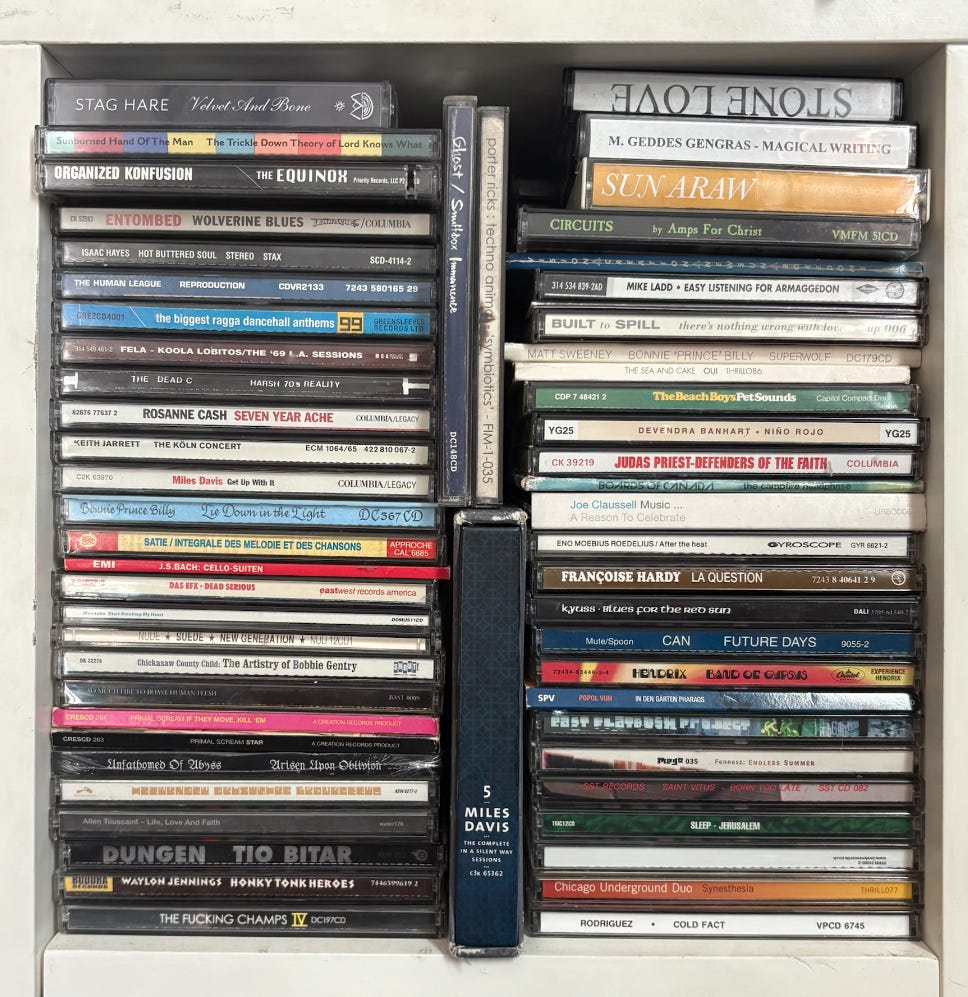
To start with, plenty of Elder Millennials, Gen X people, and Boomers continued to buy enough music to support an entire cultural sector—from musicians and record labels to record stores and music magazines—well into the age of Napster, Soulseek, and The Pirate Bay. What’s more, a lot of us discarded those CD jewel cases and inserted the discs into large floppy black books, rendering the media ineligible for resale, yet much easier to transport. You definitely know someone who has several hundred CDs preserved in these hefty portfolios, physical media caches hoarded by cultural preppers like so many Jim Bakker Doomsday Slop Buckets.
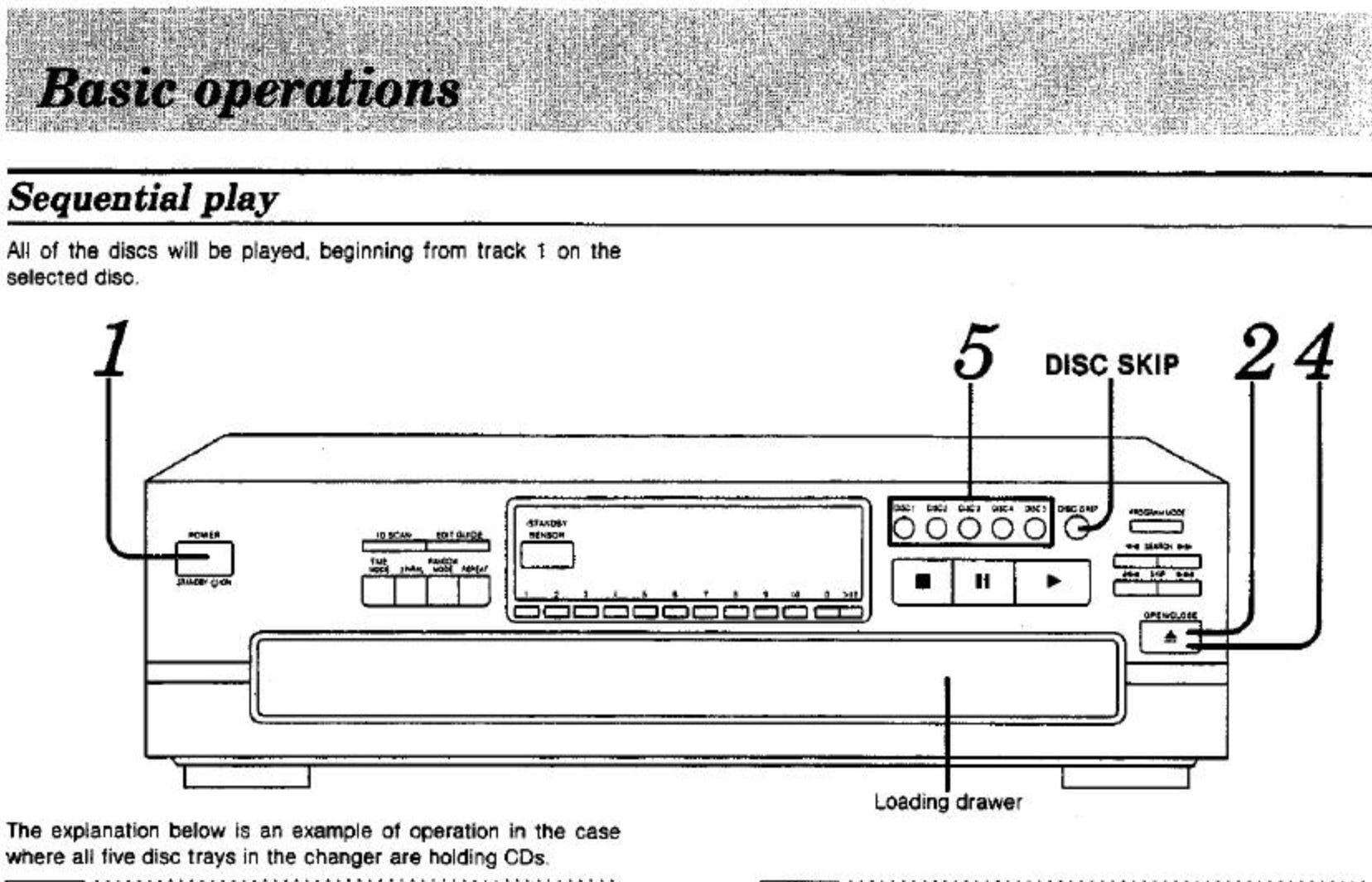
I have a 25-year-old five disc CD changer that works fine even though I lost the remote over a decade ago. In theory, there are components that will eventually wear out, but in practice it works like new. There is no forced obsolescence: no operating system to be updated, nor logins to be forgotten. If you want to upgrade, a few companies still manufacture exorbitantly expensive audiophile CD players: The Crutchfield catalog ranks the $6,500.00 McIntosh MCT500 unit as among the best CD players of the year. Or you can find Technics SL-PD888 Compact Disc Changers like mine for $50 on Ebay.
If you don’t want to deal with a dedicated CD player, a low-end CD/DVD drive costs about the same as an antique CD player. I use a cheap LG Slim Portable DVD writer that I got from Best Buy for $35. That’s an example, not a recommendation: The first one I bought died after a couple years of moderate use, because that’s just how tech is these days, part of the brilliant strategy of manufacturing disposable products with carcinogenic materials that last forever. In comparison, the Technics SL-PD888 from 1998 has never given me any trouble, and is partially made of metal.
I don’t know if Apple Music still lets you import CDs, but there are several clunky but totally functional programs that will rip your CDs into multiple formats, from Ogg Vorbis to AIFFs. These apps are free and rarely updated, and they look as cheap and outdated as that might imply. But they work! I use one called XLD, which is a clever acronym for X Lossless Decoder. If that doesn’t do the trick, I turn to fre:ac, which stands for Free Audio Converter. Rest assured that these developers have not wasted a dime of the donations they occasionally solicit on interface design, user experience, or branding.
As for formats, audiophiles can debate the sound quality of WAV vs AIFF vs FLAC vs MP3, but after reading many articles and reddit posts, the majority opinion seems to be that if your soundsystem is booming, your hearing is undamaged, and your neighbors won’t call the cops, you can probably detect the difference between 320kbps MP3s and FLACs at high volumes. But the upgrade to WAVs or AIFFs is beyond the range of human perception.
II. Buy Music from Artists Even if You’re Only Ever Gonna Stream It
Unless you are purchasing vinyl, CDs, cassettes, 8-tracks, or novelty USB drives, you are not paying for the cost of manufacturing the medium upon which the music is conveyed. What remains is an ephemeral but essential component of the price of art: Compensating the artist for their time and their labor. It is a subtle but powerful shift in perception to consider any work of art as an accumulation of the creator’s time.
Musicians spend decades honing their skills and acquiring instruments and equipment, and put months or years of time and money into writing, rehearsing, and recording that music, so it feels good to give them $9 for the privilege of experiencing this documentation of so many hours of their finite lifetime. It’s like dropping change into a busker’s hat, except the busker is the nine-piece devotional drone-rock ensemble Godspeed You! Black Emperor playing their album in full at your house and they’ll pause if you have to run to the bathroom or want to get something to eat from the kitchen. And they’re only asking us to give each player one dollar.
I’ve yelled a lot in previous newsletters about the good and the bad of Bandcamp. The TL;DR is that Bandcamp is an amoral company that will do whatever they want to maximize the profits—such as firing all of their unionized employees as well as over 80% of their BIPOC and LGBTQ+ employees in 2023, shortly after the original owners sold the platform to the multinational video game conglomerate Epic Games who promptly sold the company to a firm that licenses music for Taco Bell commercials—but AFAIK they still offer the best deal for artists.
ID Music: Bandcamp Sunday November 2023

TFW it's easier to imagine the end of Bandcamp than the end of capitalism
When you buy something on Bandcamp, your money hits the artist’s PayPal in 24-48 hours—less Bandcamp’s fees—and congratulations you just helped your favorite musician pay for the tube of toothpaste they’re buying later this afternoon. You can even add a little note that says “hell yeah” and sometimes they’ll write back “thanks bud” and suddenly listening to music is human again. What’s more, you don’t have to cancel your Spotify account or actually download the files in order to do this.
III. Used CDs are Cheap and Plentiful
As for acquiring physical media: Vinyl sounds wonderful, record sleeves are beautiful to look at, and a few retain or even increase in value, but they are also complicated to manufacture, often very expensive, and always inconvenient to listen to, especially if you’re used to the seamless streaming music experience. Putting the bong down and raising yourself from the couch isn’t actually that much hassle, but as someone—maybe Julian Cope?—once said of Tangerine Dream’s immersive “dark ambient” album Zeit, “the only flaw is you have to get up to flip the record over.”
Used CDs on the other hand are easy and cheap to produce, and thus plentiful and usually inexpensive4. Show up at Half Price Books after an elderly hesher got shipped off to the nursing home, leaving their grandkids to hastily sweep out their storage space, and you’ll complete your Judas Priest and Iron Maiden collections with a grip of $5 portable FLAC archives.
you [apologetic tesla guy; careless cultural leech]:
dangit the blutooth won’t connect and the white supremacist stereo won’t play rap music after the last update
me [driver of 2006 subaru with only three functioning doors; wise arts patron]:
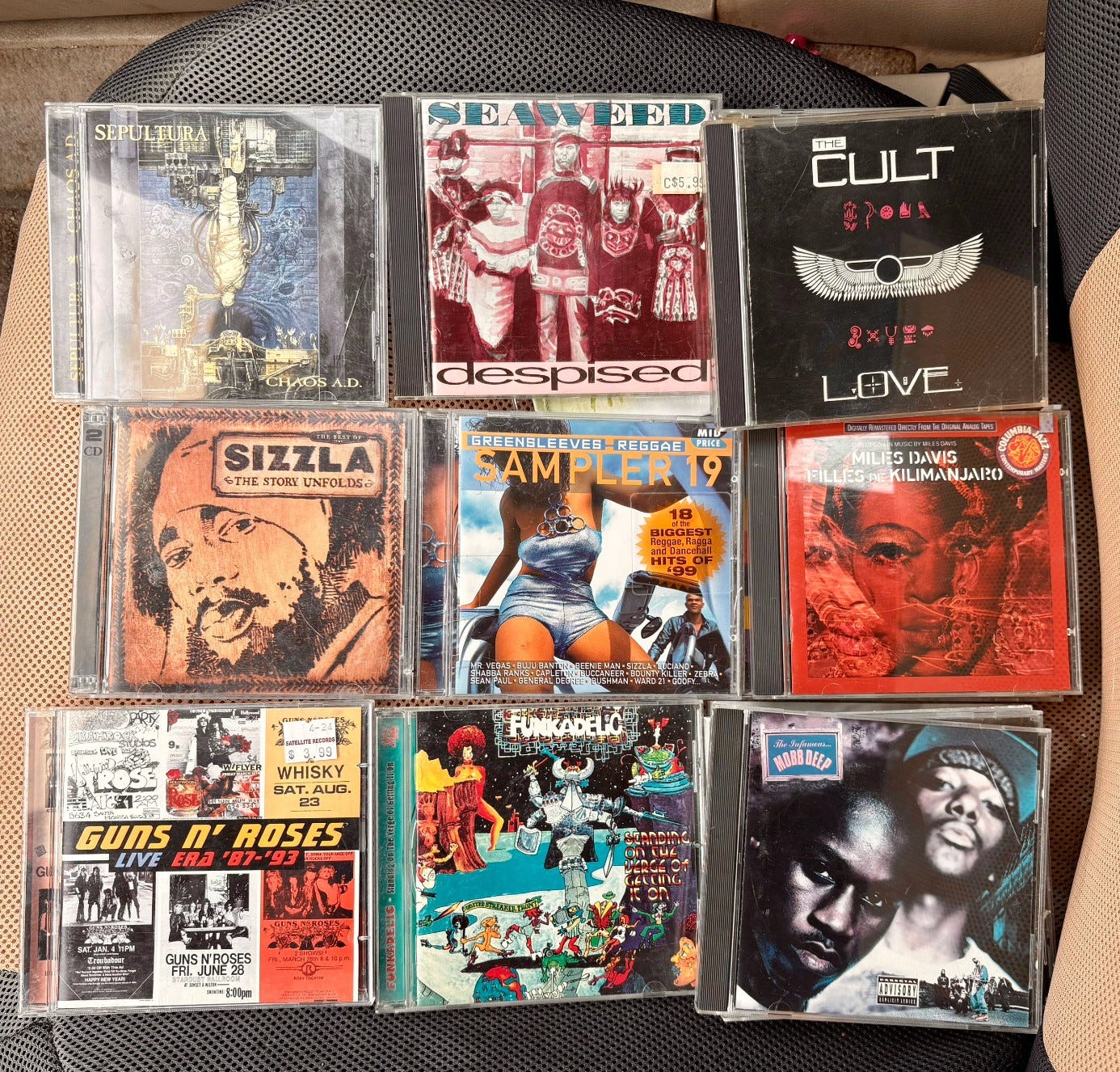
Miles, Axl, Sizzla, Prodigy, Eddie Hazel and the Cavaleras called shotgun; you’ll have to ride in back and also the driver-side back seat door doesn’t open
Most independent record shops are focused on vinyl, however there’s almost always a sad little CD table in the back. But you’re gonna get some attitude. The last time I bought a used CD was at the very cool Satellite Records in Kalamazoo, Michigan. My buddy picked up a bunch of local weirdo freak scene vinyl, while I scored a busted-up copy of G’ n’ F’n’ R’s extremely mid Live Era 87-93 on sale for $5. The middle-aged guy running the store scoffed at my choice, but I was happy to indulge him in a little nostalgia for the days of pretentious record store clerk tyranny, as a treat.
III. (Don’t) Acquire Music Without Paying for It, Which Is Shady
Unless we’re talking about checking CDs out from your local library—which is a thing!—this option may be a much sketchier way of acquiring music. But based on my highly subjective yet not insignificant experience with musicians over the last 30 years, a lot of them are begrudgingly okay with low-volume, non-commercial piracy at this advanced stage of the decline and fall of the music industry. A few artists I interviewed back at the dawn of Napster were already off-the-record OK with file-sharing on the grounds that they’d rather more people hear their work. Several decades later, as the ability to make money as an independent musician has been nearly destroyed by streaming, many now openly broadcast5 the bitter message “if you can’t afford to buy it now, please pirate my shit rather than using Spotify, and maybe come see us when we play in your town.”
Beyond torrents and Soulseek—two things that still confuse me—you may be surprised to learn that audioblogs still exist. For reasons that I do not understand, nor do I care to research, they’re often Spanish or Portuguese-language blogspots, ranging from conscientious reggae collectors digitizing out-of-print vinyl selections, and forever-stinky crust punk elders posting lossless rips of their no-fi cassettes, to goth bootleg collectors with a trove of ‘80s Cure SBDs, and classic rock hoarders sharing FLACs of The Allman Brothers’ 247 album (!) discography. There are also blogs with a lot of Cyrillic and—sorry to be slav-phobic—but I usually don’t click around on those.
If you can crack the mysterious Spanish code for words like “download” plus “discography” plus “blogspot” and tack on the name of the band you’re looking for, who knows where you’ll end up. The Mediafires are still burning if you know where to look for the smoke signals, but it’s VERY IMPORTANT to learn how to accurately determine which DL button is a DL button and not a nasty porno-game pop-up or malware download.
I AM NOT ADVISING ANYONE TO DO THIS.
Unauthorized downloading has always been mostly illegal, dubious ethically, and unsafe technologically. Don’t do it! But if you’re buying used CDs the artist isn’t gonna see any of that money anyway? We all make our own choices.
IV. How To Play Music on Your Computer Without Itunes
Swinsian is one of the most useful tools for dodging the rent extraction schemes of music streaming platforms without relying on the extremely unpleasant Apple Music Retail Interface. Swinsian has everything good about peak iTunes plus a lot more, and I shill for it whenever I can because it has made listening to music much more enjoyable for me. It took me a couple years of suffering the degradations of each new Apple Music update, and unsatisfying tests of so-called Itunes-killers that were scammy SaaS subscriptions, or prioritized streaming music over native files. I want Swinsian—which is maybe just one guy?—to be around for a long time.
The app has a one-time license fee that includes a couple rounds of updates including esoteric features that will surely delight fellow holders of unwieldy native digital music libraries. If “support for separator characters in the composers field” gets your juices flowing and you use a Mac, Swinsian may be relevant to your interests.

While Swinsian is compatible with Ipods and Apple telephones, I took a step further outside of the rotten Apple ecosystem and splurged on a single-function Sony Digital Walkman. Like Swinsian, it is optimized for playing music. It doesn’t sell anything, you can’t download anything other than music files from your computer, and it doesn’t play TV shows or movies. The model I purchased a few years ago has Bluetooth, but no wi-fi connectivity. Sadly, newer, more expensive models do connect to the internet and offer streaming options, but you can find used Sony NW-A55s on ebay for $100-200.
I don’t know if any of this makes a difference other than giving me the subtle sense of empowerment that comes from refusing to listen to music the way the tech industry tells me I have to listen to music. But in such dark times, reclaiming a sliver of autonomy is worth a little inconvenience. And as anyone who’s ever dealt with a stuttering Bluetooth connection in the middle of a party knows, the idea that the surveillance state was going to be super convenient is extremely outdated. Returning to the proto-Luddite language from Dōgen’s Shōbōgenzō, “Even if unwholesome action fills worlds upon worlds, and swallows up all things, opting-out is emancipation.”
This summer I was housesitting for New Mexico friends while they were on a long road trip, camping their way around the Pacific Northwest. Late one night we were coming down from a heavy “medicine journey” and listening to music on the only stereo in the house, an audio system that required wi-fi connection along with an app that required a login and then the only way to play music via the app was to log in to another streaming service that was compatible with the audio system’s app. Other than forcing the listener to use a streaming service subscription, there is no reason why these speakers—which sounded very nice—couldn’t have an aux-in. But they do not have an aux-in, so listening to music without an internet connection and several logins was not possible.
Sometime around midnight, the music stopped out of nowhere and we both jumped. My fellow traveler got up to mess with her phone—always a risky thing to do during medicine journeys!—and saw that we’d been kicked out of the app for some reason, and the password wasn’t working anymore. There was no way that we were going to call our vacationing friends at midnight for tech support, but suddenly we were afraid that maybe we’d been logged in to their Spotify account. Were our attempts to restart the music pinging a barrage of two-factor authentication texts to their backcountry campsite? Could they see that we had been listening to Miguel’s “Adorn” on repeat? Or worse, were we overriding their attempts to mellow out to Townes Van Zandt around the campfire with our obsessive slow jamming?
Rather than further harsh the mellow with password recovery attempts, we adjourned to the front porch, relieved that we could access IRL field recordings of the wind in the trees without wi-fi or login credentials.
Of course you can also avoid Spotify by listening to Inter-Dimensional Music on the airwaves of Marfa Public Radio, streaming on Mixcloud, or download it and take things offline. If you can’t figure out how to buy music from artists you can subscribe to Vøid Contemplation Tactics and I will spend your money for you. Thank you!
It’s also super encouraging when you share this with your nice friends. Regardless, thank you for being here.
Inter-Dimensional Music 2025.11.09
mixcloud / download
For this week’s session, it’s an hour of post-industrial electronics, long-form heavyweight death sludge, blackened dubbing, and screwed and chopped new age tapes.
Language throughout the broadcast from Joko Beck’s Everyday Zen, as read by your host:
To continue practice through severe difficulties we must have patience, persistence, and courage. Why? Because our usual mode of living—one of seeking happiness, battling to fulfill desires, struggling to avoid mental and physical pain—is always undermined by determined practice. We learn in our guts, not just in our brain, that a life of joy is not in seeking happiness, but in experiencing and simply being the circumstances of our life as they are; not in fulfilling personal wants, but in fulfilling the needs of life; not in avoiding pain, but in being pain when it is necessary to do so. Too large an order? Too hard? On the contrary, it is the easy way.
Our program begins, and eventually comes to an end, with rolls and waves of rhythmic ambience from Sounding the Deep. Programming note: Be careful searching the web for “sounding the deep” as it is an uncomfortable-looking fetish thing in addition to an old-timey sailor thing.
artist — work
Sounding the Deep - Canopy Mist
Raime - The Last Foundry
Primitive Man - Natural Law (Cosmic Chambo FCC-edit)
Sinead O’Connor - Fire on Babylon
Portishead - Mysterons (Live at Roseland)
Dub Syndicate - JA Minor
Evan Caminiti - Babylonians
Pacific Walker - Induction Ceremony
Kamalesh Maitra - Raag Megh
Pantha du Prince - Welt Am Draht (Moritz Von Oswald Version)
Sounding the Deep - Thunderheads
I’m going to use Spotify as the example because they are the worst and most offensive, but I’m also talking about Apple Music, Amazon Music, Tidal, or companies using the same rent-extraction strategies that I don’t know about.
I avoid nostalgia-core listening and enjoy exploring contemporary music from people much younger than I am, so I love King Gizz and the Liz Wiz because they are one of the first bands I’ve encountered that has a massive and seemingly very cool fan community but I 100% do not get what they are doing. Although I think this might mean they’re a jam band, as that’s the primary category of music where I do not understand what’s going on.
My updates on migrating this newsletter to Ghost are getting annoying, but . . . Substack still sucks and yet there are things about Ghost that I don’t like so I’m stuck trying to figure out if I can move the whole thing to some kind of Wordpress/Patreon combo? “No ethical consumption under capitalism” blah blah blah but mostly I just don’t have the energy to figure all of this mess out. I have, however, mostly extracted myself from an Adobe CS subscription, if you’re keeping score?
Side note: Anybody looking for a VG+ copy of 808 State’s Newbuild for less than the $135 high price on Discogs, or seeking to spend less than $100 for a VG- 1987 German CD of Bad Brains’ Rock For Light should get in touch.
This is a stark contrast with the writers I follow on social media who have more recently been forced into the gig economy model that now defines cultural production. Newsletter writers—many of whom I love—are much faster to come down HARD on anyone complaining of paywall fatigue. This is also understandable, but yelling at normal people who are frustrated that they can’t finish an article without signing up for another subscription seems as effective as yelling at the rude call center worker telling you that your insurance claim has been denied: Two relatively powerless people making each other feel worse.
so many good things here... thank you cosmic baba .. thanks for all the prompts and reminders, great sounds and quotes, keeping me dharmic aligned when i've let my own akashic dishes pile up and my pee stains on my spiritual toilet get smellier than i prefer, but i must have been all too busy trying some make some sense of the world around me and my own programmed alignements... anyhow thank you, from a small, tucked away, second floor hut in Morjim, Goa..
A follow up to a previous conversation. I did not get back into the NBA this year as I thought your NBA related post may lead me to do ... mostly because I'm keeping busy with creative shit, so that's good!