
The More You Don't Know
Buddhist chanting, wooden techno, and revisiting Timber Rattle's devotional backcountry rituals

This essay about the music of Timber Rattle originally appeared in the online music magazine Aquarium Drunkard in September 2021. Since then, Aquarium Drunkard has paywalled their website1, so I’m republishing a modified version of “Ritual del lo Habitual: Timber Rattle and the Value of Not Knowing” for free on Vøid Contemplation Tactics, with this new introduction. Jailbreaking and re-wilding my words to mark the release of Ritual Fever from Water is the Sun, a collaborative project from Timber Rattle’s Adam Parks and Mkl Anderson.
Since I first encountered Timber Rattle’s eerie backcountry devotionals during the height of the COVID-19 pandemic, Parks’ work has become one of the mainstays of Inter-Dimensional Music FM, my understandably unpopular yet remarkably long-running broadcast media art project combining heavy mellow music and non-self improvement aphorisms, that has aired each Sunday night at 11pm in the Chihuahuan Desert of Far West Texas and Northern Mexico since 2010. Since federal funding for public media was eliminated by the Republican administration, Marfa Public Radio is now 100% funded by its listeners. Today is the last day of their Spring Membership Drive, so if you’d like to join me in supporting the FM radio station that has kept these heavy mellow sounds on the airwaves for over 15 years now, click here:
SUPPORT THE FUTURE OF MARFA PUBLIC RADIO
and INTER-DIMENSIONAL MUSIC FM

Parks’ music as Timber Rattle, lightning white bison, and in collaboration with Anderson as Water is the Sun, is an ambient, forest goth variation on the pastoral, melancholic occult folk music that I’ve chasing since first encountering the “Sunshine Superman-meets-Hamburger Lady”-sound of Current 93 way back in 1993. It still gives me the deep sense of satisfaction as when I first heard Fairport Convention crossed with Neil Young on the hand-lettered TDK SA90 Type II Compact Cassette my Uncle Rich made for me in high school, an auspicious simultaneous introduction to Everybody Knows This is Nowhere on Side A, and Unhalfbricking on Side B.
Like Kieran Hebden’s first albums as Four Tet, or his more recent collaborations with William Tyler, Timber Rattle and Water is the Sun offer something much stranger than sentimental pastiche. I don’t know that I would’ve been able to tell you that I wanted to hear what mournful British psychedelic folk music would sound like remixed into a chillout tent format until another first encounter, this time with the smears of bucolic post-techno jazz-folk on Four Tet’s Pause when I was as an editor at URB in the early ‘00s. The jazz influence is less pronounced with Parks’ music, but it’s there in an alchemical “Little Church” sort of way, the addition of hillbilly ragas turning Hermeto Pascoal, Teo Macero, and Miles’ recipe into something gamier and Appalachian, a Spice Witches Stew.
I don’t think we URB editors were responsible for coining the the term “folktronica,” but we were definitely early adopters. I can't find the place where he says this, but Florian Meyer aka Don't DJ2 described one of his projects as "wooden techno" which is less cringe name for a similar sort of sound. Here's some of his mesmerizing wooden techno inspired by Sun Ra:
A decade later, after I’d left Los Angeles for the high desert grasslands of Far West Texas, I came across a new variation on these themes with the music of Stag Hare and the artists of the “New Weird Utah” scene, a collaborative community producing strains of jingle-jangling arid lands ambiance under names like Silver Antlers, River Spirit Dragon, Wyld Wyzrdz, and Seven Feathers Rainwater. A Great Basin echo of these Great Smoky Mountains vibrations, and a component of ID Music on Marfa Public Radio since its launch. The ecosystem is preserved in terrarium on the Backcountry Chillout Volume I mixtape I made as part of a fundraiser for one of Arthur Magazine’s several resurrections.

I’ve never met the New Weird Utah folks—who are now dispersed beyond Utah, still making new weird music, e.g. Willow Skye-Biggs TAFKA Stag Hare and the Inner Islands label—but I created the album cover art for Seven Feathers Rainwater’s 15 Apple Musicians, and commissioned work from Stag Hare as part of her extraordinary Tapestry project: “Improvised long form zones creating a singular larger structure, totaling four hours in sound, ebbing and flowing in subtle shifting tones and moods.”
As with my very old Aquarium Drunkard contributions, this Vøid Contemplation Tactics project is an excuse to write about Zen under the cover of writing about music. I paid the rent as an editor, critic, and journalist for nearly a decade in Los Angeles from the late ‘90s through the late ‘00s, the last era when you could turn “having music opinions” into “having health insurance.” But I’ve always found writing about music to be kind of excruciating, and was grateful to shed the critic skin I wore at URB for the even more elusive job of “writing stories about taking drugs with compost wizards who take drugs to make compost to grow drugs with” at Arthur. But one of the upsides (?) to the catastrophic and heartbreaking dismantling of the music industry and the ensuing collapse of the cultural journalism industry that relied on record label advertising to survive is that it’s a lot easier to achieve direct experience of unusual and obscure music like Water is the Sun than in the days when you had to bet $20 or $30 that the Current 93 import CD you were buying was going to be closer to Thunder Perfect Mind than Dogs Blood Rising.
Anyway, People Die

After my dad and I talked on the phone about the eulogy he’d written for his sister, I sat for awhile listening to Current 93.
I envy the writers I worked with as an editor so many years ago who have ascended to the heights of what remains of the publishing industry, but I can escape those egotistical traps by reminding myself that first of all, I was pretty successful as a writer, even financially for a few years, and it is crazy to not be grateful for that good fortune. Likewise, I’m incredibly stoked to still be writing for all of you people reading this newsletter.
But that professional success didn’t make me any happier than I am now. It was the opportunities for adventure and connection that came from being involved in underground culture that brought me joy, the relationships with people that I still talk with 30 years later, and the people I still meet every few years because of the Arthur bumper sticker on the 2006 Subaru Outback that’s still rattling along after 20 years of bumping down desert tracks and forest service roads. Meanwhile I haven’t bothered to revisit most of these printed words in ages, despite carting my plastic tub archive of URB, Arthur, LA Weekly, RES, Spin, Budget Travel, High Times, and The Big Issue from Los Angeles to Santa Cruz to Marfa to Indianapolis and now to Muncie over the last couple decades. It was always a thrill when a new issue of Arthur arrived from the printer, but tumbling down booming Kelso Dunes by moonlight with a head full of fungi is a faster route to attaining “the freedom and poverty of Zen.” It’s taken 30 years of tumultuous career changes to understand that I don’t crave success, I crave community.

Whether you wanna call it folktronica, wooden techno, or occult acoustic ambient jazz, this new weird music that is deeply intertwined with wilderness experience has been profoundly meaningful to me because it has been incorporated into my lived experience in ways that I can’t adequately express, regardless of how carefully I fine tune the medicines, which in these dark days of middle age is more often a doctor-prescribed speedball of amphetamine salts and low-dose benzos.
I intend to continue Vøid Contemplation Tactics for free for the foreseeable future due to the opportunities and connections that it has created with you 650-ish readers and lurkers, 37 of whom are literal angels graciously subsidizing the ever-expanding ID Music bandcamp library with paid subscriptions. That being said, I have recently recovered an elusive sense of equanimity by turning to my Zen practice rather than my various unmonetizable creative practices as a possible means of subsidizing my Type 1 diabetes hobby: At the end of May I start a Clinical Pastoral Education internship at St. Vincent Hospital in Indianapolis, the first step toward possibly hopefully perhaps becoming a Zen chaplain.
In addition to figuring out how many “business attire” outfits from the back of the closet still fit, one of my tasks is to determine how to pursue the requisite credential in a “spiritual/values-based orienting system” that complements the clinical experience of sitting with people in crisis. I’m neither a dharma teacher nor a Buddhist priest, and I only have 80 hours of yoga teacher training. But I don’t know if leaving my apostate earthbound teachers and going deeper into spiritual enclaves at this point is the right path.
In considering these questions, I’ve been reading Zenju Earthlyn Manuel’s The Shamanic Bones of Zen, and featuring her language on recent episodes of ID Music. Manuel is an ordained Zen priest, but she has a perspective on practice that is as steeped in mystery, magic, and wilderness experience as this music I’m writing and not-writing about. As with any true Zen text, there are no answers within her pages, but as I have learned from a lifetime of losing myself in obscure sounds and getting lost on backcountry trails, a good ear and a compass are more important than field guides.
“Although I have had many teachers, Buddhist and non-Buddhist, I spend time out in the wilderness to access the wisdom of the bones,” she writes. “Zen is for those who ask the question, ‘What is this life?’ but do not really want an answer.”
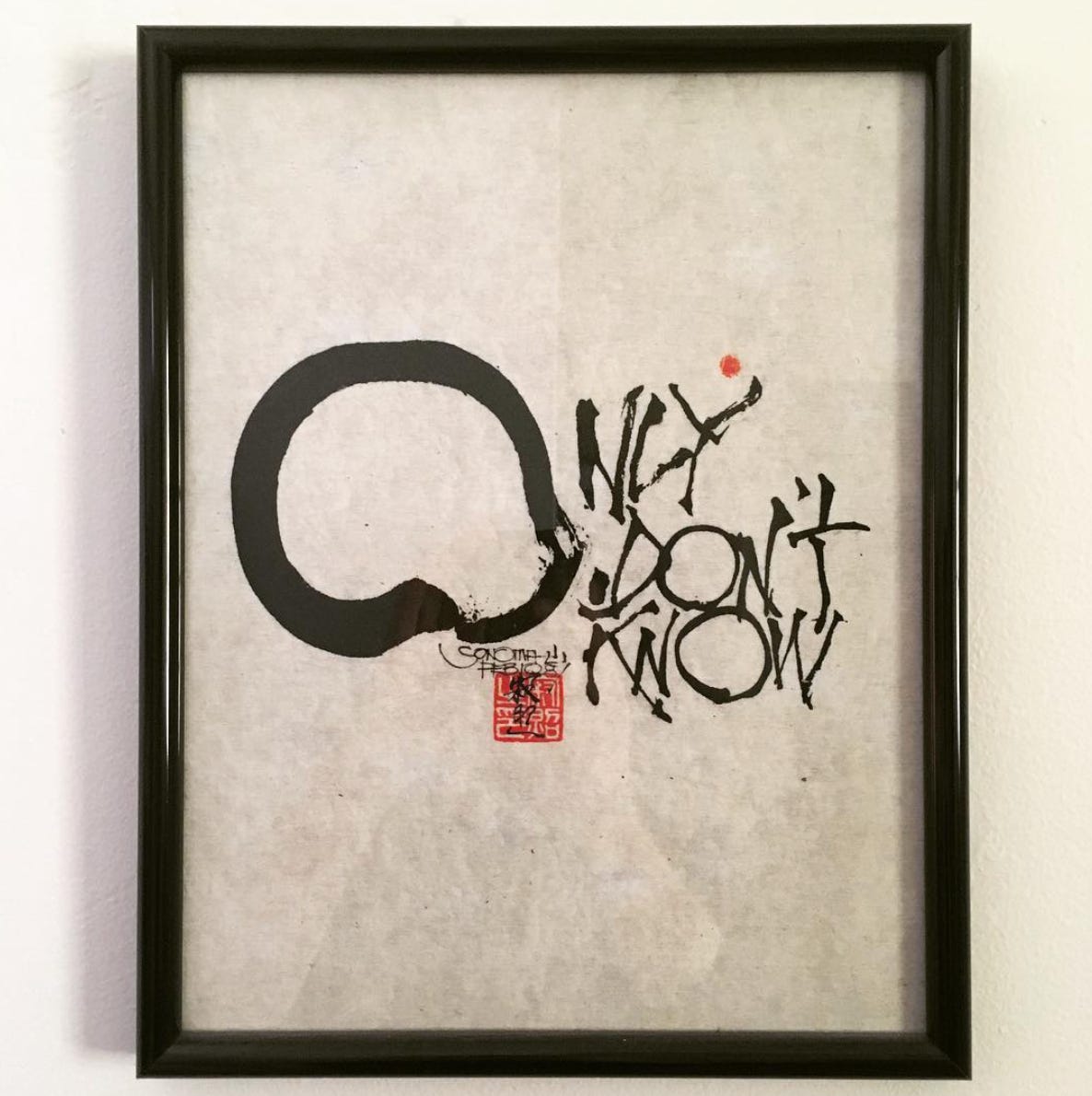
Or as Zen Master Seung Sahn famously proclaimed: “Only don’t know.”
Water is the Sun is currently on tour in North America: Click here for tour dates.
The Indianapolis Zen Center will host a one-day meditation retreat with Dennis Duermeier JDPSN of the Kansas Zen Center on May 9, 2026. The program begins at 7:30am, and concludes at 3:30pm. Suggested donation is $25, though no one will be turned away for lack of funds. For more information on monthly retreats and weekly meditation practice at IZC visit indyzen.org.
Or feel free to drop me a line with questions: I’m no longer an IZC resident, but I’m planning to be there.

Ritual de lo Habitual: Timber Rattle and the Value of Not Knowing
(Originally published in Aquarium Drunkard in September 2021)
I walked away from my first visit to the Indianapolis Zen Center wondering if I’d been initiated into a cult. Despite practicing zazen for years, I was unfamiliar and slightly unnerved by the chanting ritual that started the group’s Wednesday night meditation practice. I was greeted at the door by three gray-haired and gray-robed white men, who offered a friendly but brief introduction that mostly consisted of pointing out the bathroom. Soon after, I was standing behind my cushion staring at a well-worn chanting book. One of the dharma teachers knocked out a methodical “tok-tok-tok” on the moktak, a hand-held percussion instrument. We began by repeating the line…
na-mu bul-ta bu-jung gwang-nim bop-he
…three times, interspersed with bows and prostrations. We continued on through variations on these tangled phonemes for 10 more minutes. My voice faded in and out of their three-part harmonies as I puzzled over how to pronounce the unrecognizable combinations of letters. I also hesitated because my fellow practitioners hadn’t explained that we were chanting about the bodhisattva of compassion—Kwan Seum Bosal aka Avalokitesvara, Kannon, or Guanyin—in phonetic Korean, and that I wasn’t pledging myself to a Midwestern Nxivm franchise.
There’s an amplified sense of occult power when you know you’re close to acquiring secret knowledge, a feeling that’s increasingly elusive as the all-seeing algorithm develops new and faster ways to disseminate information. When I first heard Timber Rattle, a cryptic band with unspecified ties to the Blue Ridge Mountains, California’s Grass Valley, and Upstate New York, I wondered if I was listening to someone else’s arcane cult initiation.
I was deep into the “devotional” tag on Bandcamp, and growing weary of digging in the seemingly endless digital crates of kirtan. The sound of rapturous hippies doing Sanskrit sing-a-longs, strumming away on acoustic guitars, and jingling hand drums in a suburban yoga studio is often a far cry—both literally and figuratively—from the sound of Alice Coltrane in the Sai Anantam Ashram.
Timber Rattle uses a comparable sonic palette, but the ritual comes across way heavier. The intertwined voices chanting and moaning on their 2013 phantoms of place album were just as indecipherable to my ears as Swamini Turiyasangitananda’s devotional singing, or the phonetic recitations heard in Korean Zen temples.
“he’eile moloa’a” begins with 30 seconds of silence before a slow throbbing tone emerges. This presages the arrival of a methodically-picked guitar and at least one—but maybe two or three?—reverberating voices that rise in mournful harmony. Soon a keyboard—or is that a harmonium? or Pauline Oliveros on accordion?—begins to sigh, adding another breath to the chorus, everything respirating into a hypnotic blur. The effect is like an earthbound Sigur Rós, or Liz Fraser gone Pentecostal: vocals without obvious denotative meaning structured into sentences of pure connotation. The language appears to be Hawaiian: “moloa’a” translates as “matted roots,” and is the name of the Kauai beach where they filmed Gilligan’s Island. I failed to find a translation for “he’eile” on its own, and the two words together only point back to Timber Rattle. The rest of the album’s 40-minute runtime covers similar ground. It was just the sort of unmarked backcountry seep of organic ritual trance that I’d hoped to soak in, after passing by so many soft-focus day-spa jams.
Several trails led away from phantoms of place. Before long I was puzzling over at least eight Timber Rattle albums, tour tapes, and two collaborations with lightning white bison, an artist working the same esoteric soil. Digital and cassette versions were spread across two labels from the Czech Republic, and the Virginia-based Burial Dance. Bloomington, Indiana’s Bluesanct Records handled the vinyl. Scouring the web outside of Bandcamp didn’t reveal much more, other than a brief 2015 interview with Potlista, a Czech ‘zine. The band’s 2021 album, god walks the dark hills, isn’t even listed on their Discogs page. Timber Rattle does not go out of their way to explain what they’re doing, and yet they’ve been doing it for a decade or longer.
The rest of Timber Rattle’s catalog offers variations on these crunchy pastoral drones and arboreal dirges. The collaborative releases with lightning white buffalo, grazing the storm floor (2017) and chrysoprase (2019), are more likely to harsh the mellow with grumbling guitar grind and subtle dissonance. These efforts bring to mind Ben Chasny and Al Cisneros’ sacred riff geometries, or Pelt’s clangorous trip-reports. Thinking in terms of Indo-Appalachian fusion, Timber Rattle’s vocal-heavy performances are a slow-crawling dhrupad complement to the frenetic violin and piano-heavy ragas that shimmer across Pelt’s most recent Reticence Resistance album.
Timber Rattle’s 2018-19 albums—animal water, high desert hymns, and the veil beneath the mountain beneath the veil—foster a mellower devotional sound, filling raga-like structures with mountain gospel signifiers and field recordings. The effect is both bucolic and gloomy, like forest-bathing in the dankness of a deep holler, catching a whiff of musk from a hidden den, or inhaling the scent of creosote under the heavy skies of a desert monsoon. The weight is undeniable, making Timber Rattle the rare band that can shift between the slow-burning radiance of Brightblack Morning Light’s ritualistic country-soul, and the mesmerizing crush of “tribal” metal that Neurosis initiated with Pain of Mind‘s “Takeahnase.” There’s also an analog with the syncretism of Phurpa, the Russian collective performing proto-Buddhist shamanic rites in line with Sunn O)))’s amplifier worship catechism. Practicing at altitude often produces feelings of spiritual ecstasy, hypoxic reveries regardless of whether the thin air’s provenance is Appalachian or Himalayan.
Field Recordings from the Sunn I

An Inter-Dimensional Music Supersession for Sunn-bathing and Nag Champa huffing
How does music produce a devotional effect? And how is that differentiated from the overlapping descriptors “ritual,” and “tribal?” The latter term is often more problematic. Neurosis has refined a sound on their own, in solo efforts, and with the Tribes of Neurot side project to the point where “tribal metal” usually just means “sounds like Neurosis.” If one isn’t identifying the style of a specific tribe, the adjective derives its meaning from exotic stereotypes and racist caricatures. But devotional and ritual traditions from Nyabinghi riddims to 5Rhythms expand on the idea of ambient music as aural wallpaper. These sounds are incomplete without connection to some other activity, be it communing with spirits via ecstatic dance, passing a smoldering chalice, eating of the bread and drinking of the cup, or simply washing the Zen Center dishes. It shouldn’t fade into the background, but it also needs to complement your set and setting.
One can sometimes experience the devotional aspects of such music more clearly by giving up on efforts to understand the mystery. My taste in heavy music includes a lot of self-described “ritualistic death metal.” For my purposes the rituals in question are a lot more intense when left as abstractions of universal suffering, cosmic dread, or gastric distress, leaving any rote blasphemy or hyperbolic descriptions of cruelty lost in translation.
There’s a tendency toward overcompensation on the heavier end of the folk and ambient music spectrums where Timber Rattle might seem at home. Metal artists dabbling in acoustic guitars and repetitive synthesizers often distinguish their sounds as “dark folk” or “dark ambient,” which gives away too much. It also suggests that those musics were previously lacking in somber tones. If “Waitin’ Around to Die” isn’t filed under dark folk, then what does “dark” even mean?
Not that Timber Rattle makes it easy to go behind the music, or even sing along. The interviewer from Potlista asked some of these questions about the band’s use of language from the perspective of a non-native English speaker. The band member present, Adam Parks, clarified their intention:
I think [the lyrics] end up mostly being just a verbal exploration of the same things that the music is exploring. Land and bodies and life and death and magic and language and ritual and myth and space and cycles and animals and plants and food and poison, etc, etc… and our relationships to any and all of those things. I really like singing, especially with the harmonies, but the lyrics are intentionally kind of obscured, since the sound itself is more important to the music than being able to understand the words. I think the “meaning” can be real distracting.
There’s a reason why the dudes at the IZC didn’t offer me an in-depth explanation of Kwan Seum Bosal chanting. This particular Buddhist sect wasn’t a cult, but the Zen Center was an intentional community offering cheap rent. I ended up living there as a member of their religious commune for a couple years. One thing that I learned is that Zen isn’t about thinking your way into answers. It’s about experiencing the questions as they are, and sitting with the uncertainty that remains.
After a few more months of weekly practice, I suggested that we offer first time dharma room visitors enough context to know that we weren’t pledging allegiance to a guru or committing to any proprietary cult-branded body modifications. Linc, IZC’s 75-year-old guiding teacher, eventually agreed. He began to riff on variations of an idea expressed in Wanting Enlightenment is a Big Mistake: Teachings of Zen Master Seung Sahn:
When chanting, or sitting, or bowing, even special practice cannot help you if you are attached to your thinking. Taoist chanting, Confucian chanting, Christian chanting, Buddhist chanting don’t matter. Chanting “Coca Cola, Coca Cola, Coca Cola…” can be just as good if you keep a clear mind. But if you don’t keep a clear mind, and are only following your thinking as you mouth the words, even the Buddha cannot help you.
Zen is about what you can attain by letting go of things, and what you can learn by accepting the things you can’t learn, practicing what Seung Sahn called “only don’t know.” He paired this with the maxim “only go straight,” which has never really worked as well for me. Seung Sahn was a Korean immigrant, and while his dharma is no less profound for its ESL-ness, there’s a cultural context to both Coca-Cola and “going straight” that obfuscates the teaching. By “go straight,” I’m guessing he means something more like “go forward,” a wayfinding directive that is free from connotations of heteronormativity or blind obedience. Likewise, keeping a clear mind while chanting the name of a hegemonic multinational corporation’s toxic flagship brand may require a lot more effort than doing so with Topo Chico, or better yet, a fully non-proprietary non-sequitur.
Leaving the debate over the effect of casting brand name hexes for another time, the point stands. Listening to Seung Sahn or Timber Rattle isn’t going to give you any answers. But they both offer the opportunity for accessing transcendent spiritual experiences without getting distracted by their meaning.
Previously on Void Contemplation Tactics . . .
ID Music: Autumn 2021 Digest

A four-part series of programs loosely based on my annual essay for Aquarium Drunkard where I use music as a way to proselytize about Zen. Readings from Zen Master Seung Sahn’s Wanting Enlightenment is a Big Mistake throughout.
Scene Report: Indianapolis is Enough

Water is the Sun visits Indianapolis, plus Bandcamp Friday recommendations
Why Dost Thou Hide Thyself in Clouds?

Dark adaptations of corporeal reality made with fog juice, kosmische death metal, and James Turrell
Vøid Contemplation Tactics welcomes all anonymous lurkers!
If you’d like to make me feel better about the money, time, and energy that I put into producing a volunteer FM radio program and free newsletter, you can subscribe (for free) and give me a welcome hit of dopamine. Or you can subscribe for money and help me feel guilty about not sending newsletters more often!
If you’d like to support me without giving money to SubstaKKK, you can drop something in the tip jar.
It’s also super encouraging when you share this with your nice friends. Regardless, thank you for being here.
As I wrote in the “Liquid Advertisement & Gaseous Desire,” issue of this newsletter in 2024, after first discovering that my work was paywalled,
To break it down into simple terms, I wrote for free about musicians who give their music away for free. I want to share that writing on my free newsletter in the hope that maybe two or three of you might come out to support one of those musicians who is playing a small show on a small tour at a small bar that may or may not have a cover charge for the show. If you would like to read what I wrote for free about the music that the artist gives away for free [and the common ground that music shares with a Buddhist meditation practice that is available for free] you have to pay $100 to the company that hosts the web page where my essay is posted.
Which is fine, as it’s a good website publishing the work of good people writing about good music.

One thing I adore about this certain type of usually European producer is how hard they work to evade attention. While metal people are arguing over whether or not their sound should be classified as blackened death metal, the New Wave of Old School Swedish Death Metal, or technical disso-death, there are sprawling genres of electronic dance music called “funky” and “bass.” So what do you mean you weren't aware that the artist named "Don't DJ" released an EP in 2023 called "Album Sampler"?